
Introduction
Each year iFusion® Research conducts an independent post-harvest survey of soybean growers in Manitoba, Ontario and Quebec. What makes this study unique is that results are collected at the individual variety level, after harvest when growers know how their varieties actually performed.
In addition to measuring planted acres and herbicide trait adoption, the study examines the factors that influence variety selection, grower satisfaction with key variety characteristics and the information sources used in the decision-making process.
The results presented here highlight some of the major market trends observed in 2025. More detailed analysis by variety, company, province and market segment is available exclusively to study sponsors.
Soybean Acres and End Use
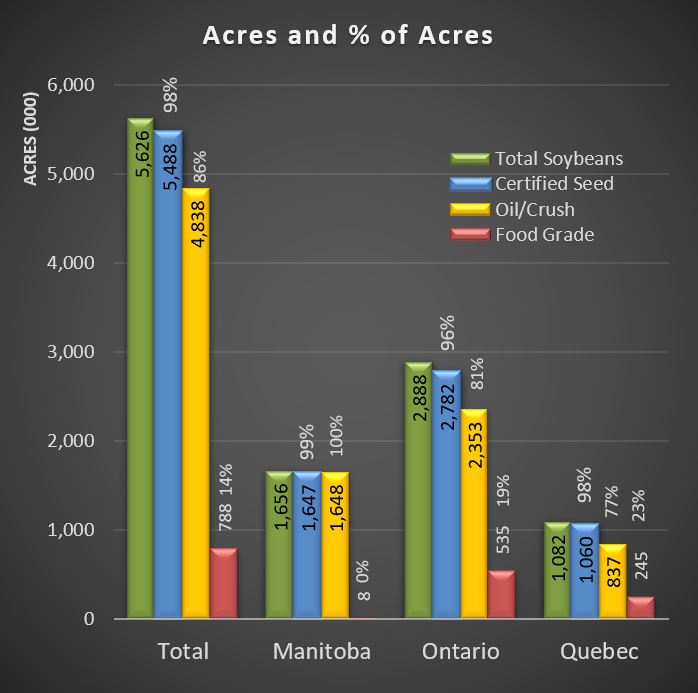
Soybean acreage reached approximately 5.6 million acres across Manitoba, Ontario and Quebec in 2025, remaining relatively stable compared with 2024. Manitoba recorded its highest soybean acreage on record, while Quebec also reached a record level despite a decline in Ontario acreage.
Nearly all soybean acres, 98.7%, were planted with certified seed, representing approximately 5.5 million acres.
Oil/crush varieties accounted for 86% of certified soybean acres, while food-grade varieties represented 14%, virtually unchanged from 2024.
Food-grade soybean acres remain concentrated in Ontario and Quebec. Food-grade varieties represented approximately 23% of Quebec soybean acres and 19% of Ontario soybean acres, compared with less than 1% in Manitoba.
Soybean Herbicide Trait Adoption
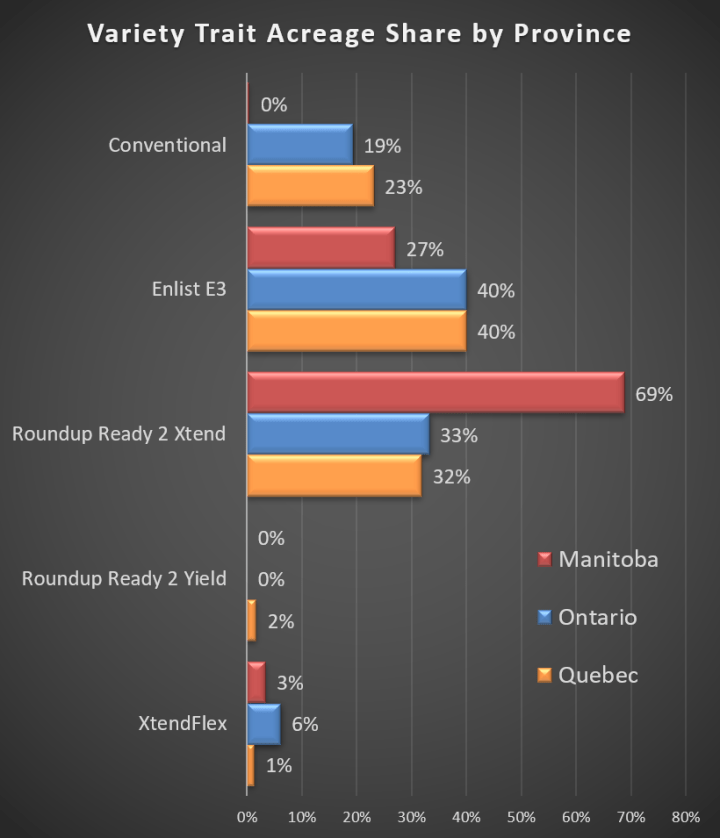
Roundup Ready 2 Xtend® remained the leading herbicide trait in 2025, accounting for 44% of certified soybean acres. The trait continues to dominate the Manitoba market while facing increasing competition in Ontario and Quebec.
Enlist E3® continued its rapid expansion, increasing certified acres by more than 50% from 2024 to capture 36% of the market. Adoption increased across all three provinces, making it the fastest growing herbicide trait platform in the study.
Conventional varieties, largely associated with food-grade production, accounted for 14% of certified soybean acres, similar to 2024.
XtendFlex® remained a relatively small segment of the market at 4% share but continued to grow, increasing certified acres by approximately 37% from 2024.
What Matters Most in Selecting a Soybean Variety
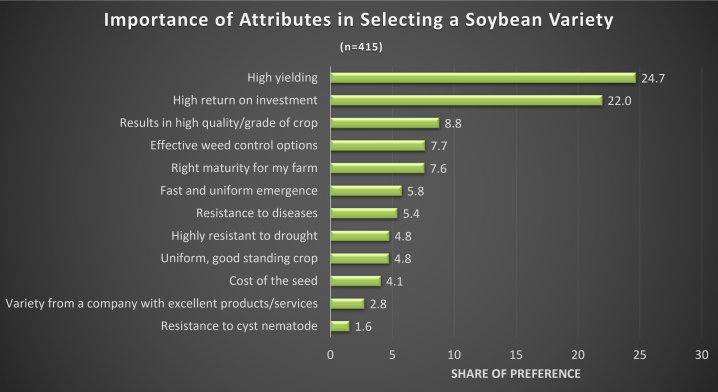
High yield and high return on investment remain the two most important factors influencing soybean variety selection. In 2025, high yield accounted for 25% share of preference, followed by high return on investment at 22%.
These two attributes have consistently ranked as the most important factors over recent studies. Many agronomic characteristics, including weed control, disease resistance, emergence, standability, maturity and drought resistance, are important because they contribute to the broader grower objective of improving yield, quality and profitability.
Results in a high quality/grade of crop ranked third in 2025, followed by effective weed control options. Regional differences exist, with effective weed control receiving greater emphasis in Manitoba while high quality/grade is relatively more important among Quebec growers.
Resistance to soybean cyst nematode remains the lowest priority attribute overall.
Variety Satisfaction
Canadian soybean growers continue to express strong overall satisfaction with the soybean varieties they planted in 2025, although the results suggest that growing conditions influenced perceptions of performance and value.
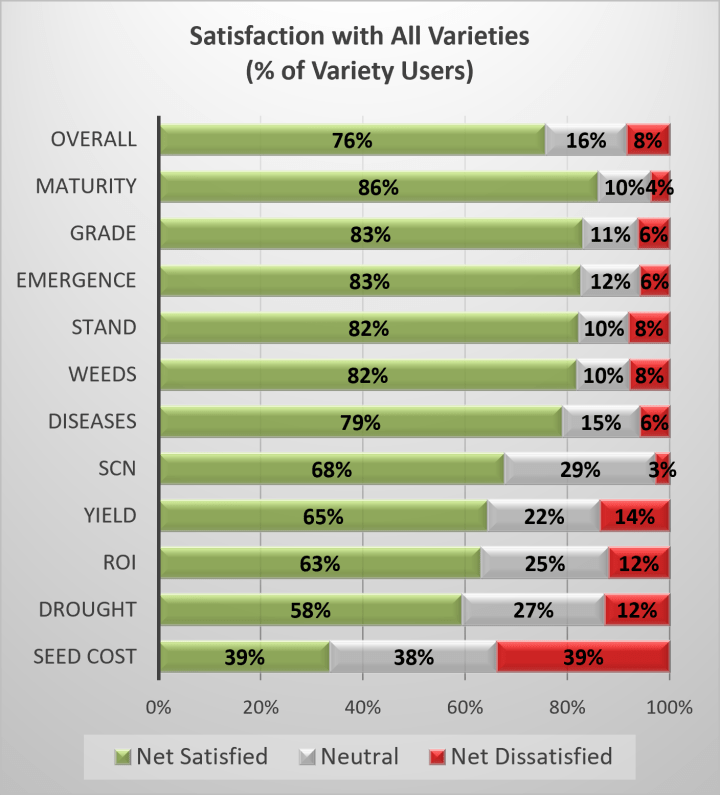
Overall, 76% of variety users were satisfied with their soybean variety, while only 8% were dissatisfied. The highest satisfaction ratings were recorded for maturity, quality/grade, emergence, standability and weed control performance, indicating that today’s soybean genetics continue to deliver consistent agronomic performance across many key characteristics.
Compared with the previous satisfaction study conducted in 2023, overall satisfaction declined modestly while dissatisfaction increased for overall performance, yield, return on investment and quality/grade. The most notable change occurred for drought resistance, where dissatisfaction increased from 7% in 2023 to 15% in 2025.
The widespread dry conditions experienced across many soybean-growing regions during 2025 likely contributed to this change. While growers expressed lower satisfaction with drought resistance, the results should be interpreted in the context of seasonal weather conditions rather than as an indication of declining soybean genetics.
Growers also became considerably more critical of seed cost. Net dissatisfaction increased from 8% in 2023 to 23% in 2025, reflecting the reality that when weather reduces yield potential and profitability, the cost of seed receives greater scrutiny even though it represents only one component of overall production costs.
Information Sources in Decision Making
Soybean growers were asked which information sources they use when making soybean seed variety decisions, as well as when those sources are used during the decision-making process.
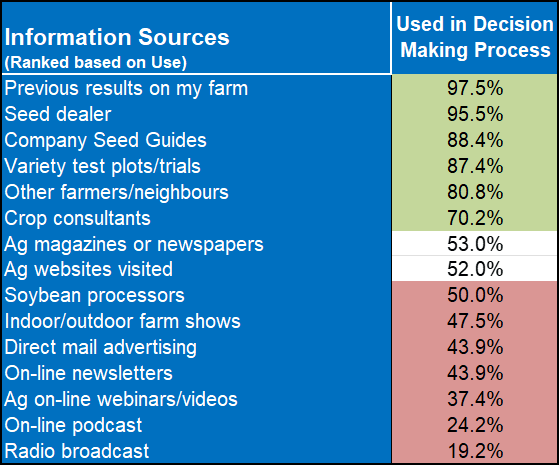
The accompanying chart summarizes the overall use of information sources during the soybean variety decision-making process.
Previous results on the grower’s own farm, seed dealers, company seed guides, variety test plots and trials, other farmers/neighbours and crop consultants remain the most widely used sources of information when selecting soybean varieties.
Agricultural magazines and newspapers, agricultural websites, soybean processors and indoor/outdoor farm shows are each used by approximately one-half of soybean growers during the decision-making process.
The results demonstrate that soybean growers rely on a broad mix of personal experience, trusted advisors, company information, independent trials and agricultural media before selecting a variety.
About the Annual Study
Each year, soybean growers across Manitoba, Ontario and Quebec participate in the iFusion Research Soybean Variety Use & Satisfaction Study. The results help seed companies, agricultural organizations and industry stakeholders better understand the Canadian soybean market while providing growers with selected independent market insights.
The information presented here represents selected highlights only. The complete study includes detailed analysis by variety, herbicide trait, province, end use, seed company and other key market segments. Detailed results are available exclusively to study sponsors.
Thank You to Participating Growers
iFusion Research would like to thank the soybean growers who participate in this research each year. Your participation helps provide independent insight into Canadian agriculture and supports better understanding of farmer decision-making across the industry.
[1] All acreage data is weighted based on Statistics Canada soybean acres by province each year. Reference: Table 32-10-0359-01 Estimated areas, yield, production, average farm price and total farm value of principal field crops, in metric and imperial units.
iFusion is a registered trademark of iFusion Research Corp. DEKALB, Roundup Ready 2 Xtend, Roundup Ready 2 Yield and XtendFlex are registered trademarks of Bayer Group. NK is a registered trademark of Syngenta Group Company. Pioneer and Enlist E3 are registered trademarks of Corteva Agriscience and its affiliated companies. Prograin is a registered trademark of Semences Prograin Inc.
“`

